
Home › Lifetime mortgages
Lifetime mortgage advice
If you're looking for lifetime mortgage advice, you're in the right place. Lifetime mortgages are the only type of equity release I arrange, across the whole market, and you deal with me from the first call to the day the money arrives.

- On the FCA register, reference JLF01060 check the register
- Pellucid Ltd, FCA number 981845 check
- Equity Release Council member my profile
- SOLLA Later Life Lending Advice Standard
Quick answer: how does a lifetime mortgage work?
A lifetime mortgage is a loan secured on your home, available from 55, and you keep owning it. Nothing is due monthly: interest rolls up unless you pay it. The loan is usually repaid from the sale of your home when the last borrower dies or moves into long-term care.
Why ask me about a lifetime mortgage?
Because a lifetime mortgage is designed to be done once and to stay with you for the rest of your life, so it has to be right first time. I'm whole of market and compare plans from the ten lenders I work with, I come to your home, and it is me from start to finish, with no hand-over to an administrator. I've specialised in later-life lending since 2009, I hold the SOLLA Later Life Lending Advice Standard and I'm a member of the Equity Release Council. Trusted Equity Release is a trading name of Pellucid Ltd, authorised and regulated by the Financial Conduct Authority, FRN 981845. The first conversation costs nothing: email me, request a printed brochure, or get in touch.
“I encourage anyone in need of equity release advisors to contact Jeremy. Thank you, Jeremy, for your complete professionalism.”
What does lifetime mortgage advice cover?
Everything that decides whether a lifetime mortgage suits you, before a lender is even chosen. The FCA's rules set out what an adviser has to weigh (MCOB 8.5A.6), and in plain English it comes to this:
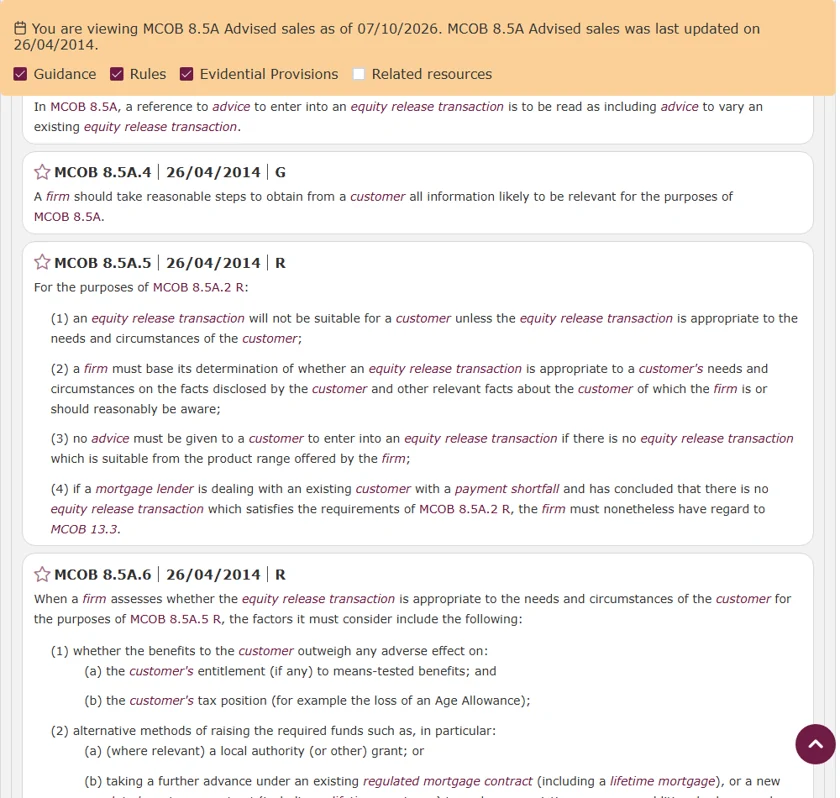
- whether the money does you more good than any harm to your means-tested benefits and tax
- whether a cheaper route would raise it, such as a grant, a further advance or a new mortgage
- whether you and your property fit the lender's criteria
- what you want to leave your family
- your health and life expectancy, which can improve the terms
- your plans, such as moving house or needing more money later
- whether to pay the fees up front rather than add them to the loan
The one people underestimate is the inheritance. If a plan would stop you leaving what you'd hoped to leave the children, I'll tell you that, and why, before anything goes to a lender. Before you sign, you'll have the personalised illustration on paper. FCA rules make this advice a requirement on every lifetime mortgage, for reasons I set out on the adviser page.
Should you pay the interest or let it roll up?
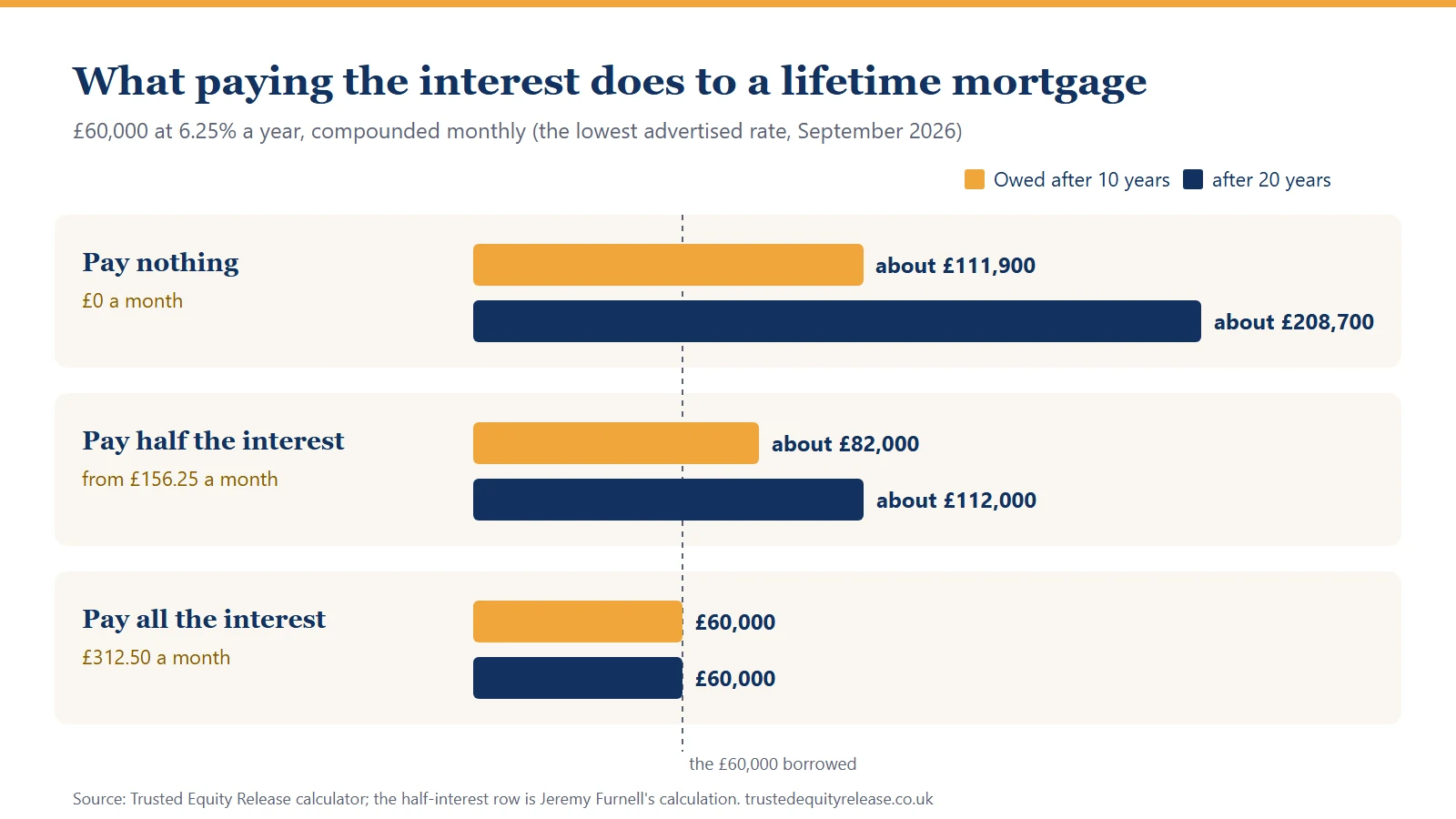
Pay what your income comfortably allows, because every pound of interest you pay is a pound that stops compounding. Depending on the lender, you can pay nothing, pay from £50 a month, or pay 25%, 50%, 75% or 100% of each month's interest. Here's what that does to a £60,000 lifetime mortgage at 6.25% a year, fixed for life, the lowest advertised rate in September 2026:
| What you pay | Monthly cost to start | Owed after 10 years | Owed after 20 years |
|---|---|---|---|
| Nothing | £0 | about £111,900 | about £208,700 |
| Half the interest | £156.25, rising as the loan grows | about £82,000 | about £112,000 |
| All the interest | £312.50 | £60,000 | £60,000 |
Interest is compounded monthly, as on my calculator page, and the half-interest row is my own calculation. Paying half the interest for 20 years leaves you owing roughly what you'd owe after 10 years of paying nothing. The rates lenders are charging now are on my rates page.
On an optional-payment plan you can stop if money gets tight, and the interest rolls up from then on. Under 55, a payment term plan makes the interest compulsory: see borrowing before 55.
Should you take a lump sum or a drawdown?
Take a drawdown if you don't need all the money now: you borrow a first amount, keep a reserve for later, and pay interest only on what you've taken. LV=, one of the lenders I compare, starts its drawdown plan at £10,000 and lets you take further amounts of at least £1,500, no more than once a month.
The reserve isn't guaranteed, though: Legal & General and LV= both say so, and LV= says it can be reduced or removed in certain circumstances. If you know you'll need the money, for a new roof next spring, say, borrow it up front.
A lump sum of tax-free cash suits one large cost, such as clearing an existing mortgage, which must be repaid from the release anyway. Returning customers taking more from their plans accounted for about £500m of 2021's £4.8bn of lending, the Equity Release Council said.
FAQ
Are lifetime mortgages any good?
What are the downsides of a lifetime mortgage?
What happens to a lifetime mortgage when you die?
Is a lifetime mortgage the same as equity release?
Is a later life mortgage the same as a lifetime mortgage?
How much can you borrow with a lifetime mortgage?
Does your health affect a lifetime mortgage?
Sources
- MoneyHelper: lifetime mortgages
- FCA Handbook, MCOB 8.5A.6: the factors an equity release adviser must consider (checked 7 Oct 2026; screenshot kept)
- FCA Handbook glossary: lifetime mortgage
- Equity Release Council: product standards (partial repayments, no negative equity guarantee; checked 7 Oct 2026; screenshot kept)
- Legal & General: lifetime mortgage drawdown (reserve not guaranteed; checked 7 Oct 2026; screenshot kept)
- LV=: Lifetime Mortgage Drawdown+ (£10,000 start, £1,500 minimum withdrawal, reserve not guaranteed; checked 7 Oct 2026; screenshot kept)
- Trusted Equity Release: equity release statistics (FCA sales data; Equity Release Council lending figures)
Book your free initial consultation today.
Pick up the phone and speak to Jeremy directly. If equity release is not the right choice, I will say so.
07768 972861 Or try the quick calculator